Densho Encyclopedia

 Media
Media
Hirabayashi v. United States
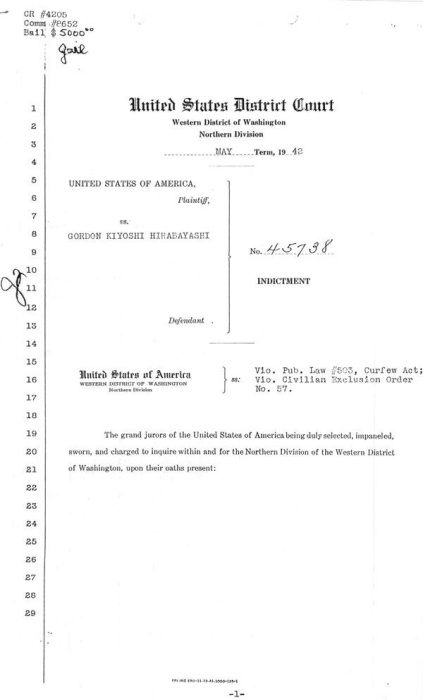
Hirabayashi v. United States was one of four Supreme Court cases involving challenges to the wartime treatment of Japanese Americans. Gordon Hirabayashi, as acts of civil disobedience, violated both the curfew order issued against Japanese Americans and the exclusion order requiring them to leave their West Coast homes. He was convicted, and, on appeal, the Supreme Court affirmed his conviction. [1]
Hirabayashi's Violation of the Military Orders
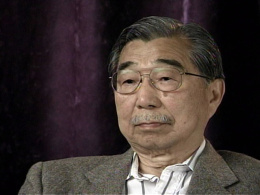
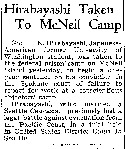
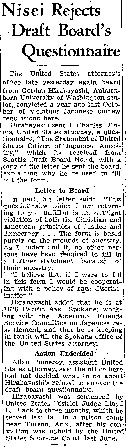
Gordon Hirabayashi was a twenty-four-year-old senior at the University of Washington when he decided to resist the exclusion orders requiring Japanese Americans to leave their West Coast homes. Accompanied by lawyer Arthur Barnett, he turned himself in to the FBI and handed agents his written statement, which stated, in part: "If I were to register and cooperate[,] . . . I would be giving helpless consent to the denial of practically all of the things which give me incentive to live. . . . I consider it my duty to maintain the democratic standards for which this nation lives. Therefore, I must refuse this order for evacuation." While Hirabayashi's intent was to challenge the exclusion order, entries in his diary showed he had also violated the curfew order. Thus, he was charged with violating both orders.
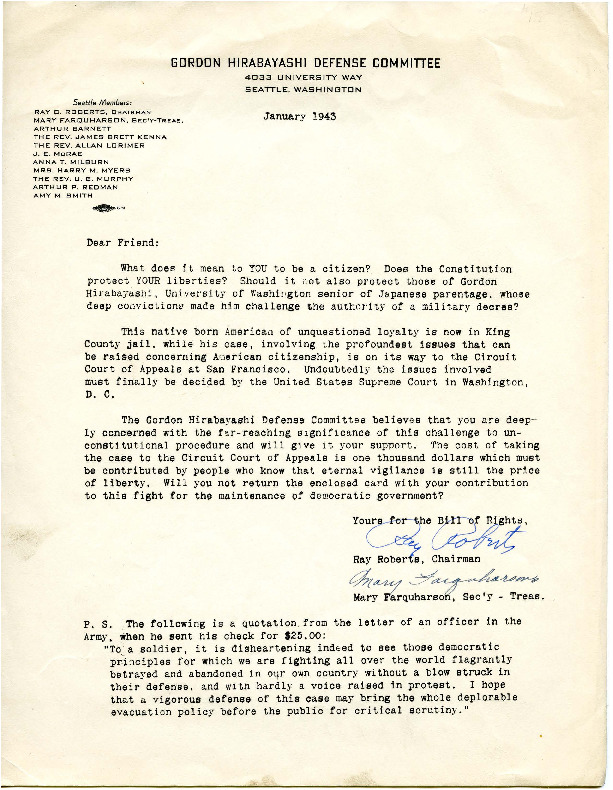
State Senator Mary Farquharson formed a committee to support Hirabayashi's case. The group and the local chapter of the American Civil Liberties Union (ACLU) eventually arranged for Frank L. Walters to represent him.
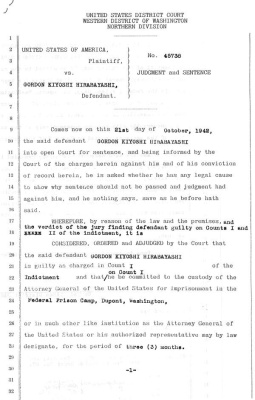
Walters first asked the court to dismiss the charges, arguing that the orders violated the constitutional guarantees of due process and equal protection. On October 20, 1942, Hirabayashi, after spending five months in the King County jail in Seattle, appeared in court before Judge Lloyd D. Black. Judge Black did not hide his view of the potential for espionage and sabotage among Japanese Americans: "[P]arachutists and saboteurs, as well as soldiers of Japan make diabolically clever use of infiltration tactics . . . [and] are shrewd masters of tricky concealment among any who resemble them." [2] He found the orders constitutional and denied Hirabayashi's request for dismissal.
Hirabayashi's Trial and Appeal to the Ninth Circuit Court of Appeals
Hirabayashi's case proceeded to trial before a jury. Despite the conventional expectation that juries be allowed to deliberate the charges and evidence, Judge Black told the jury to find Hirabayashi guilty. Hirabayashi was of Japanese ancestry; he was subject to curfew and exclusion orders; and he violated both. Based on those facts, Black told the jury, "you are instructed to return a finding of guilty, and if you will not you are violating your oath." The jury quickly returned guilty verdicts on both counts.
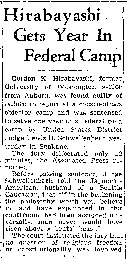
Judge Black sentenced Hirabayashi to thirty days on each count, to be served consecutively. Hirabayashi said he had heard that he could serve his sentence outdoors if his sentence was over ninety days, given the nuisance of processing papers for a shorter sentence. He'd accept a longer sentence if he could serve it at a road camp. Judge Black obliged and sentenced Hirabayashi to ninety days for each count, to be served concurrently. Hirabayashi accepted, not knowing the later legal implications his decision would have.
Hirabayashi appealed. On February 19, 1943, the U.S. Court of Appeals for the Ninth Circuit heard oral argument in Hirabayashi’s case along with the appeals in the Yasui and Korematsu cases. After arguments, however, rather than decide the cases itself, which it would normally do first, the court certified legal questions in each of the three cases directly to the U.S. Supreme Court. In Hirabayashi's case, the Ninth Circuit asked the Supreme Court to decide the constitutionality of the curfew and exclusion orders.
The Supreme Court
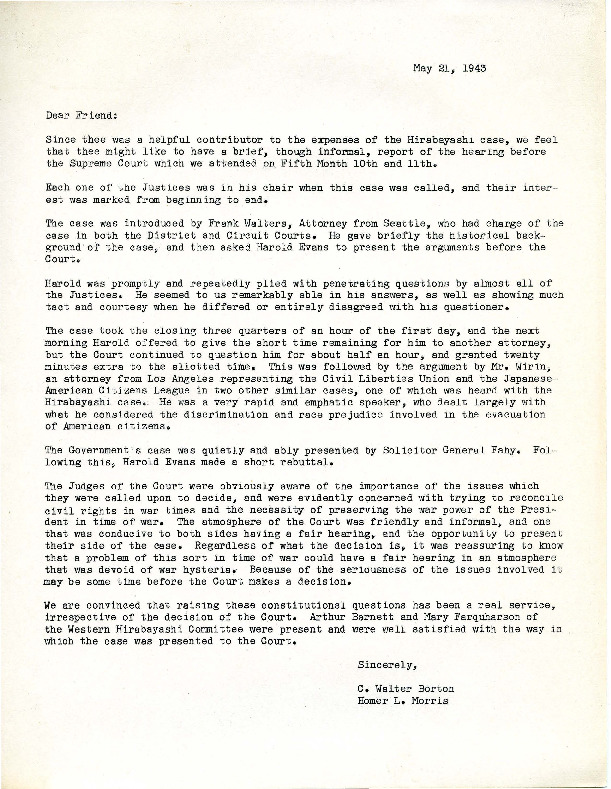
On May 10 and 11, 1943, the Supreme Court heard oral arguments in all three cases. Philadelphia lawyer and prominent Quaker Harold Evans joined Walters in arguing for Hirabayashi. By this time, the national ACLU had control over Hirabayashi's Supreme Court appeal. Because the national ACLU had refused to take any position attacking Roosevelt's authority to issue Executive Order 9066 , Hirabayashi's lawyers could challenge only the actions of Congress and General John L. DeWitt , the military commander who issued the challenged orders. Hirabayashi's lawyers argued that Congress, in passing Public Law 503 , had improperly delegated unbounded power to military authorities and that DeWitt, in issuing his orders, had acted in a manner that discriminated against Japanese Americans. Amicus briefs in support of Hirabayashi and Minoru Yasui were filed by the Northern California branch of the ACLU and the national Japanese American Citizens League , in a turnabout from its prior opposition to cases challenging the government's orders.
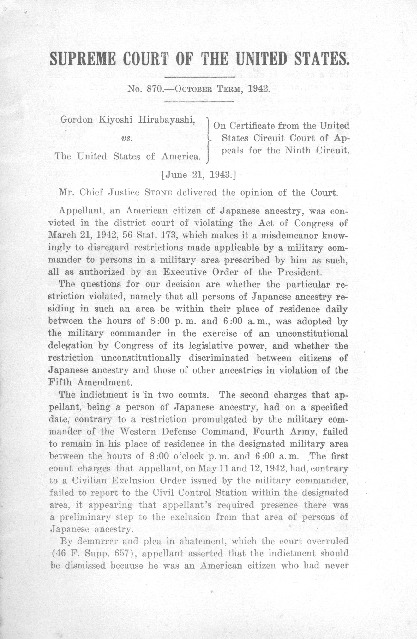
The Supreme Court issued its decision on June 21, 1943. While the Court was unanimous in upholding Hirabayashi's conviction, three justices submitted separate concurring opinions expressing reservations regarding the majority's reasoning.
Chief Justice Stone's Majority Opinion
Chief Justice Harlan Fiske Stone wrote the Court's majority opinion. [3] Importantly, he narrowed the scope of the Court's decision to address only Hirabayashi's curfew conviction. He reasoned that, if the Court upheld Hirabayashi's curfew conviction, there would be no need to address his violation of the exclusion order because the sentences for each ran concurrently. Hirabayashi's decision to accept concurrent sentences gave the Court the ability to dodge deciding the validity of the infinitely more serious orders excluding Japanese Americans from the West Coast. It would be another year and a half before the Court addressed the exclusion order in the Korematsu case.
Further, Justice Stone, for the Court, took a stance of extreme deference towards the government's actions. He explained that Congress and the President are due great deference in matters related to war and national security. "Where, as they did here, the conditions call for the exercise of judgment and discretion and for the choice of means by those branches of the Government on which the Constitution has placed the responsibility of warmaking, it is not for any court to sit in review of the wisdom of their action or substitute it judgment for theirs." The Court would uphold the curfew order if the circumstances afforded the government a "rational basis" for its actions.
Lacking any evidence that Japanese Americans had committed or threatened to commit, any acts of espionage or sabotage in order to justify its orders, the government argued that the orders were justified because Japanese Americans had certain "racial characteristics" that made them unassimilated and susceptible to influence from Japan.
The Court accepted the government's argument, explaining, "There is support for the view that social, economic and political conditions [since] the Japanese began to come to this country in substantial numbers have intensified their solidarity and have in large measure prevented their assimilation as an integral part of the white population." It explained, for example, that "large numbers of children of Japanese ancestry are sent to Japanese language schools[,] . . . Some of these schools are generally believed to be sources of Japanese nationalistic propaganda, cultivating allegiance to Japan." And the Court noted that there "has been relatively little social intercourse between [the Japanese American community] and the white population." Those examples, like others cited by the government and the Court, drew inferences of disloyalty based on stereotype, innuendo, and unsubstantiated assertions.
The Court summarized, "Viewing these data in all their aspects, Congress and the Executive could reasonably have concluded that these conditions have encouraged the continued attachment of this group to Japan and Japanese institutions."
Acknowledging Hirabayashi's argument that the orders were racially discriminatory, the Court said, "Distinctions between citizens solely because of their ancestry are by their very nature odious to a free people whose institutions are founded upon the doctrine of equality." However, it then said that, during times of war and threatened invasion, "military authorities [must] scrutinize every relevant fact bearing on the loyalty of populations in the danger areas."
The Concurring Opinions
Justice Frank Murphy had originally drafted a dissent in Hirabayashi , but was persuaded to revise his draft to uphold the constitutionality of the curfew order. He explained, "Today is the first time, so far as I am aware, that we have sustained a substantial restriction of the personal liberty of citizens of the United States based upon the accident of race or ancestry." [4] After comparing the singling out of Japanese Americans "to the treatment accorded members of the Jewish race in Germany and other parts of Europe," he wrote that the creation [of] two separate classes of citizens in this manner "goes to the very brink of constitutional power." While he agreed that the Court should give great deference to Congress and military authorities when acting in the national defense, he cautioned that "there are constitutional boundaries which it is our duty to uphold."
However, in view of the critical military situation at the time and necessity of prompt action, he agreed there was not sufficient time to separate the loyal from the potentially disloyal in the "large and widely scattered" West Coast Japanese American community. Thus, military authorities "made an allowable judgment" in issuing the curfew order.
Justice William O. Douglas also wrote a concurring opinion. He agreed that the courts should assume that military officials act in good faith and that their orders should be upheld if their orders bear "some relation" to protecting against espionage or sabotage. [5]
However, he felt the majority opinion should have been narrowed to emphasize that treatment of individuals as a group is appropriate only if the danger is great, time is of the essence, the treatment is only temporary, and individuals have a later opportunity to prove their loyalty. He wanted it remembered that "[W]e are dealing here with a problem of loyalty not assimilation. Loyalty is a matter of mind and heart not of race. . . . Moreover, guilt is personal under our constitutional system. Detention for reasonable cause is one thing. Detention on account of ancestry is another." [6]
Justice Wiley Rutledge submitted a brief concurrence stating that, while the Executive, Congress, and military officials are due deference on issues of national security, "it does not follow that there may not be bounds beyond which [they] cannot go." [7]
After the Court's decision, Hirabayashi was picked up by FBI agents in Spokane, where he had been working, and told he was to start serving his sentence in the Spokane County Jail. However, after Hirabayashi told the U.S. Attorney of the deal he had reached with Judge Black to serve his time in a road camp, he learned that the nearest work camp was in Tucson, Arizona. Because the government could not transport him there, Hirabayashi hitchhiked there and served his time. [8]
Newly Discovered Evidence and the Reversal of Hirabayashi's Conviction
For years, Hirabayashi hoped the courts would revisit his World War II case. He got that opportunity in 1983 when he was able to reopen his case through the use of a petition for writ of error coram nobis based on proof that the government had suppressed, altered, and destroyed material evidence while arguing his World War II case. [9] The hearing in his coram nobis case was extraordinary. The government again attempted to argue that its wartime actions were justified. Further, Hirabayashi's evidence of government misconduct was supported, in part, by testimony from Edward Ennis , one of the World War II government lawyers who tried to stop the fraud from happening. Based on the evidence, Judge Donald Voorhees reversed Hirabayashi's conviction for refusing exclusion. [10] On appeal, in an opinion by Judge Mary Schroeder, the Ninth Circuit Court of Appeals affirmed the reversal of his exclusion conviction and reversed his curfew conviction. [11]
Hirabayashi's and Fred Korematsu's coram nobis cases proved that there was no military necessity for the wartime orders, providing a measure of justice for the Japanese American community. However, because both Hirabayashi and Korematsu prevailed in the lower courts, their cases never made it to the Supreme Court, and the Supreme Court opinions still stand, albeit on a discredited factual record.
For More Information
de Graf, John, dir. A Personal Matter: Gordon Hirabayashi vs. the United States . 1992; San Francisco, CA: Center for Asian American Media, 1992. Documentary Film.
Hirabayashi v. United States , 46 F. Supp. 657, 661 (W.D. Wash. 1942)
Hirabayashi v. United States , 320 U.S. 81, 96-98 (1943)
Hirabayashi v. United States , 627 F. Supp. 1445 (W.D. Wash. 1986)
Hirabayashi v. United States , 828 F.2d 591 (9th Cir. 1987).
Irons, Peter. Justice at War: The Story of the Japanese American Internment Cases . New York: Oxford University Press, 1983.
---. Justice at War: The Story of the Japanese American Internment Cases . Berkeley: University of California Press, 1993.
---. The Courage of Their Convictions: Sixteen Americans Who Fought Their Way to the Supreme Court . New York: Free Press, 1988.
Lyon, Cherstin, Prisons and Patriots: Japanese American Wartime Citizenship, Civil Disobedience, and Historical Memory , Philadelphia: Temple University Press, 2011.
Yamamoto, Eric, Lorraine Bannai, and Margaret Chon. Race, Rights, and National Security: Law and the Japanese American Incarceration. Third edition. New York: Wolters Kluwer 2021.
Footnotes
- ↑ Much of this article is drawn from Peter Irons, Justice at War: The Story of the Japanese American Internment Cases. (New York: Oxford University Press, 1983); (Berkeley: University of California Press, 1993).
- ↑ Hirabayashi v. United States , 46 F. Supp. 657, 661 (W.D. Wash. 1942).
- ↑ Hirabayashi v. United States , 320 U.S. 83 (1943).
- ↑ Id , 111 (Murphy, J., concurring).
- ↑ Id , 105-06 (Douglas, J., dissenting).
- ↑ Id , 107-08.
- ↑ Id , 114 (Rutledge, J., concurring).
- ↑ Cherstin Lyon, Prisons and Patriots: Japanese American Wartime Citizenship, Civil Disobedience, and Historical Memory (Philadelphia: Temple University Press, 2011), 108, https://archive.org/details/prisonspatriotsj00lyon/page/113/mode/1up .; Peter Irons, The Courage of Their Convictions: Sixteen Americans Who Fought Their Way to the Supreme Court (New York: Free Press, 1988), 58-59.
- ↑ Id , 61.
- ↑ Hirabayashi v. United States , 627 F. Supp. 1445 (W.D. Wash. 1986).
- ↑ Hirabayashi v. United States , 828 F.2d 591 (9th Cir. 1987).
Last updated Dec. 8, 2025, 7:06 p.m..