Densho Encyclopedia

George Hoshida
| Name | George Hoshida |
|---|---|
| Born | January 13 1907 |
| Died | April 22 1985 |
| Birth Location | Kumamoto, Japan |
| Generational Identifier |
George Yoshio Hoshida (1907-1985) was an Issei who documented his experiences and observations of numerous World War II internment and concentration camps in Hawai'i and the Mainland United States in intricate a series of intricate drawings and paintings.
He was born in Kumamoto, Japan on October 23, 1907 to Eno Sakamoto Hoshida and Yotaro Hoshida. When he was four years old, his mother, father, and older brother Matsuo immigrated to Hilo, Hawai'i in 1912 and as a result, Hoshida spent the rest of his childhood growing up in Hilo. [1] After graduating from junior high school, he began working at the Hilo Electric Company. On April 23, 1933, he married Tamae Takamoto, a Nisei born in Hawai'i, and started a family. The couple had three daughters, Taeko, June Mitsuko, Sandra Yoshiko, and Carole Aiko. He was deeply involved in the local Buddhist temple's activities and had a keen interest in judo, serving as the president of a Big Island judo federation.
Hoshida was arrested and detained on February 6, 1942, likely due to his leadership in local Japanese community affairs such as the Kilauea Central Japanese Association, United Young Buddhist Association (YBA), and the Waiakea Houselots Association. [2] Hoshida was first incarcerated in the Kilauea Military Camp on the Big Island, then at Sand Island on O'ahu. In May 1942, George was one of 109 Issei who were briefly imprisoned at Angel Island outside San Francisco, before he was sent to transfer to a succession of mainland camps including Fort Sam Houston , Lordsburg and Santa Fe in New Mexico. During the first two years of his incarceration, Hoshida was separated from his wife, Tamae, and their three young daughters; a fourth daughter was born in his absence. The family was eventually partially reunited at the Jerome , Arkansas, camp, although his wife and three of his daughters endured a difficult journey by ship to San Francisco, Angel Island, and finally arrived at Jerome on January 5, 1943. His eldest daughter Taeko, age 8, who was severely disabled after a car crash, and was left behind at the Waimano Home for the disabled in Pearl City, Oahu and tragically died while the family was incarcerated on the mainland. Hoshida was not permitted to join Tamae and his daughters at Jerome until December 7, 1943. They moved one more time to the War Relocation Authority camp at Gila River, Arizona when the Jerome camp closed.
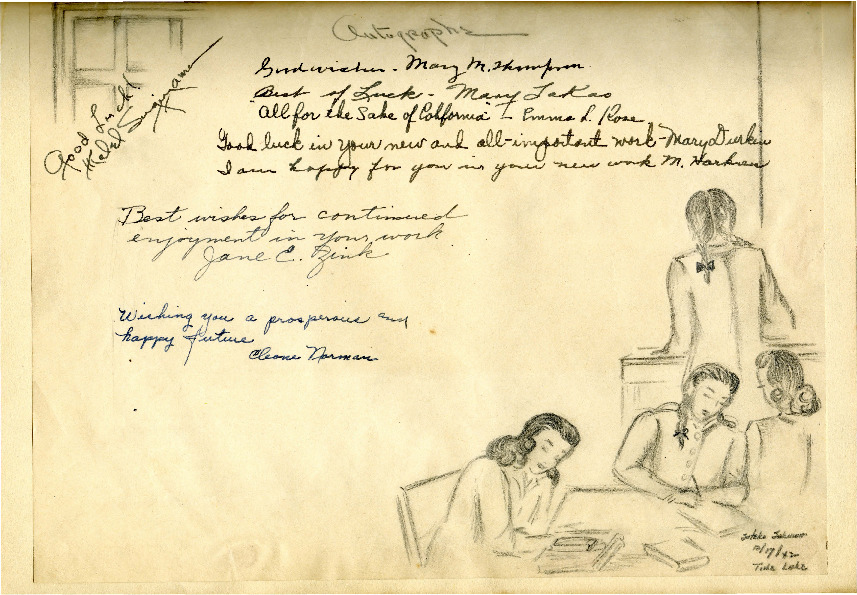
While Hoshida was incarcerated, he began filling notebooks with drawings and watercolors of his life in camp. Using pencil, ink and brush, and watercolor paints, he filled a series of notebooks, like a visual diary, which he kept between 1942 and 1945. His notebooks provide an extensive and personal record of his wartime thoughts and experiences and represent the only known depictions of the Kilauea camp. Hoshida's drawings and watercolors include portraits of fellow inmates, scenes of daily activities, and the surrounding camp environment in great detail. He also used his drawing skills to teach other inmates art. Some of his drawings were used to illustrate the 1983 volume of poetry written by Hawai'i internees, Poets Behind Barbed Wire , published by Bamboo Ridge Press.
In December 1945, Hoshida and his family returned home to Hilo, Hawai'i. In 1959, Hoshida, along with his wife and daughter Carole, resettled in Los Angeles where he worked as a deputy clerk in the municipal court and received his GED. After retiring, Hoshida returned to Hawai'i where he wrote and self-published an autobiography entitled, Life of a Japanese Immigrant Boy in Hawaii .
George Hoshida died on April 22, 1985 in Honolulu, Hawai'i at age 77. In 1996, his daughters donated his archives, including correspondences and 263 artworks to the Japanese American National Museum . Much of the collection has been digitized and is available for viewing online, including the online exhibition "The Life and Work of George Hoshida: A Japanese American's Journey."
For More Information
George Hoshida Collection. Japanese American National Museum.
Chinen, Karleen. Remembering George Hoshida." Hawaii Herald , May 3, 1985, 2.
Hirayama, Laura. "Portraits of Internment." Hawaii Herald , Dec. 3, 1982, 12–13.
George Yoshio Hoshida Oral history interview. Japanese Cultural Center of Hawai'i.
Hoshida, George and Tamae. Taken from the Paradise Isle: The Hoshida Family Story . Ed. Heidi Kim. Foreword by Franklin Odo. Boulder: University of Colorado Press, 2015.
"The Life and Work of George Hoshida: A Japanese American's Journey." Japanese American National Museum.
- ↑ United States. Honolulu Passenger Lists Jun 4, 1912–Aug 27, 1912.
- ↑ Grant Din, “The Hoshidas'Journeys Through Angel Island During World War II.” Accessed April 7, 2026.
Last updated April 8, 2026, 3:26 a.m..