Densho Encyclopedia

 Media
Media
Kenjinkai
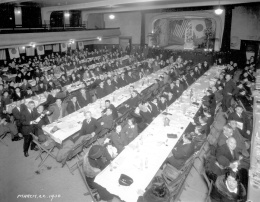
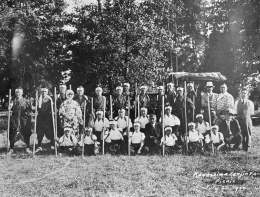
Issei immigrants often organized and joined prefectural associations called kenjinkai for mutual aid in time of illness or death, as well as for various kinds of misfortune. Ken refers to the home prefecture in Japan from which the immigrants came. Particularly during the early years of immigration when most Japanese were single men, the kenjinkai provided collective assistance to individuals from the same ken (prefecture) in Japan. In both Hawai'i and the Mainland, kenjinkai provided aid, fellowship, and a sense of community for immigrant workers thousands of miles from Japan. [1]
Background of Kenjinkai
Large prefectural groups often organized numerous local clubs for members from the same village, town, or county to foster mutual aid and fellowship. In most instances, such local clubs were formed before the kenjinkai were organized. Some kenjinkai were established when a need arose; for instance, Etsuyukai (Association of Friends from Echigo Province) was formed when immigrants from Niigata-ken began migrating to different parts of the island of Hawai'i. The Niigata Kenjinkai of Honolulu was organized in 1909 with 205 members to help unify Niigata immigrants on O'ahu. Rinji Maeyama explains the origin of its formation:
The Niigata Kenjin-kai of Honolulu was organized to collect donations from those from Niigata-ken to buy a set of new clothes for a man from our ken who committed murder and was sentenced to death. Those from Niigata-ken felt that he should at least wear respectable clothes to end his life. After that, when there were some sailors of Niigata-ken background on the Japanese naval training ships which visited Honolulu, our Kenjin-kai gave a welcome party for them. [2]
Japanese immigrants also established kenjinkai on the mainland, and, following large-scale migration throughout the Asia-Pacific region, the Japanese government enacted a new law in early 1927 regulating emigration and agricultural colonization abroad by “overseas emigration cooperatives” ( Kaigai ijū kumiai ). [3] Thus, ties continued to exist between the Japanese government and the hundreds of kenjinkai in Japanese communities that emerged throughout this region.
One of the first kenjikai in Southern California, for example, was the Kagoshima Kenjinkai , established in 1899, with many more emerging in the years that followed. Many of these kenjikai functioned independently until 1964, when Consul General Toshio Shimaouchi invited representatives of the kenjinkai to a meeting at his residence to learn more about their activities. In October of that year, the presidents of the various kenjinkai agreed to create an association of presidents named “Nanka Kenjinkaicho Renrakukai (liaison body of the presidents of kenjinkai associations). This marked the beginning of the federation of kenjinkai association in Southern California. In March 1975, the name was changed to Nanka Kenjinkai Kyogikai (Japanese Prefectural Association of Southern California), which, in 2019, represented 41 of Japan's 47 prefectures. [4] Similar unifying organizations were created in other regions, such as Oregon and Washington State, to help unite the various prefectures through a shared experience as Japanese immigrants.
Kenjinkai Prefectural Identities
As various kenjinkai emerged, so did friendly competition and an understanding of the differences between people from different prefectures. According to scholar Yukiko Kimura, “While their locality clubs provided them mutual identification and assistance at the village and town levels, they tended to be rather impersonal and even competitive on the prefectural level.” [5] The kenjinkai not only provided mutual assistance and aid, but also social opportunities for people who shared the same dialects and unique experiences of their prefecture. Many Japanese recognized distinct customs, dialects, clothing, and even characteristics of the people in each prefecture. As Bill Hosokawa points out, “Hiroshima people were said to be industrious and tight-fisted; Wakayama people aggressive and hot-tempered; Tokyoites generous, people from Kumamoto stubborn, Okayama shrewd and clever, the northern provinces patient as a result of their long cold winters.” [6]
One notable group that still celebrates a distinctive identity, even among Japanese and Japanese Americans, is Okinawans, who created their own prefectural clubs throughout California, Oregon, Washington State, and Hawai‘i. As many Okinawans immigrated years after the first Japanese migration to these areas, they not only encountered discrimination from whites but also from Naichi, mainland Japanese, who considered them “foreigners” or “outcasts.” The Naichi’s discriminatory views toward the Okinawan immigrants reflected a government-sanctioned caste system in Japan, whereby mainland Japanese treated ethnic minorities, including the Okinawans and Ainu, as lower-class citizens. At the time of immigration in the early 1900s, Okinawan immigrants were classified as “shin-Nihonjin,” or “new Japanese citizens,” following the annexation of the Ryūkyū Islands as the Okinawa Prefecture in 1879. Additionally, officials imposed Ryūkyūan-language policies that promoted linguistic and cultural assimilation at the expense of the Ryūkyūan language. [7] Despite assimilation efforts in Japan, early Japanese and Okinawan immigrants recognized these distinctions.
Transformation of the Kenjinkai
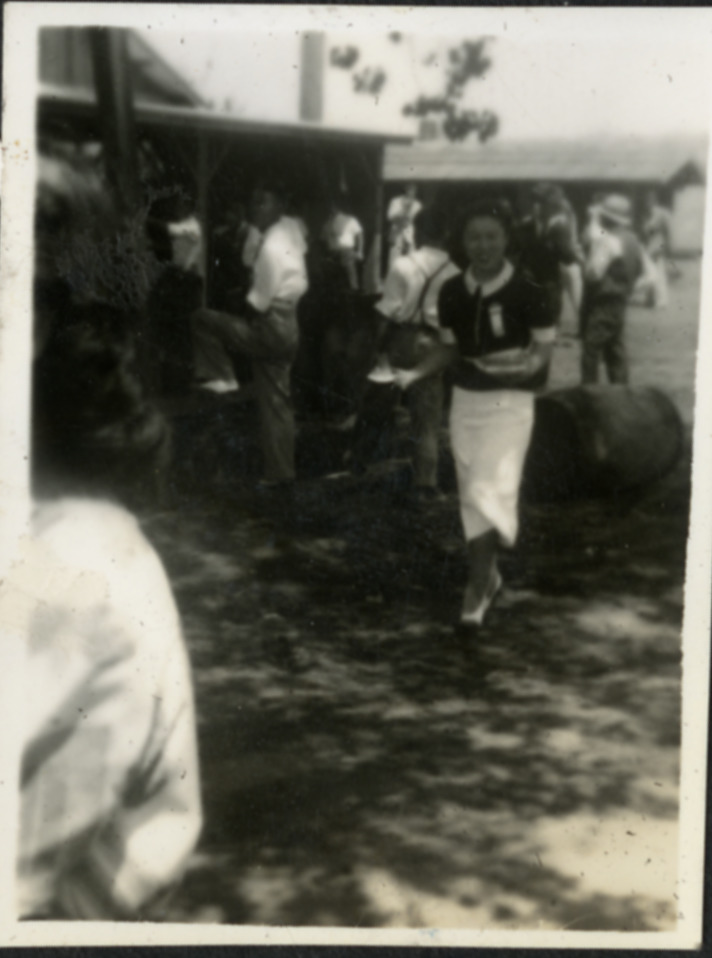
Before World War II, kenjinkai were primarily limited to immigrants from the same prefecture. However, after the war, many kenjinkai became more open in membership and "Americanized" in name and activities. For example, the Hiroshima Gōyū Kai became the Shinyū Aloha Kai after the war. Along with the name, membership rules were changed. Even today, many organizations—particularly those in Hawai'i—hold kenjinkai picnics where multi-generational Japanese Americans attend, speak a mix of Japanese and English, sing popular tunes and folksongs, play favorite games and pastimes, and celebrate an ever-evolving Japanese American culture. Scholar Dennis Ogawa points out that "rather than only trying to rekindle affections for Japan," these picnics and events organized by the kenjinkai currently "serve to bring Island communities or organizations together." [8]
Similar sentiments exist within Japanese communities on the mainland, with Janice E. Noguchi recalling that “Some of the happiest times remembered by Issei and Nisei were participating in the kenjin-kai’s social activities,” adding that, “These memories would undoubtedly be cherished indefinitely.” [9] Although some Issei were never a part of any kenjinkai because their prefectural groups were too small to organize, the kenjinkai was an essential part of the Issei experience.
Yet as the political and cultural landscape of Japanese American communities both in Hawai'i and the Mainland shifts away from the past, the challenge facing many kenjinkai today is maintaining their relevance for future generations.
For More Information
Haenschke, Kristine. “Does the Kenjinkai Have a Future.” Discover Nikkei , May 6, 2009.
Sekiya, Raymond T. "Celebrating Roots in Fukuoka." Hawaii Herald 32: 2 (January 21, 2011): 6-7.
Yoshinaga, Ida. "Staying Alive, Part II." Hawaii Herald 17:6 (March 15, 1996): A-16, 17.
Footnotes
- ↑ Research for this article was supported by a grant from the Hawai‘i Council for the Humanities .
- ↑ Yukiko Kimura, Issei: Japanese Immigrants in Hawaii (Honolulu: University of Hawaii Press, 1988), 25-26.
- ↑ Eiichiro Azuma, “US Immigration Exclusion, Japanese America, and Transmigrants on Japan’s Brazilian Frontiers.” In Search of Our Frontier: Japanese America and Settler Colonialism in the Construction of Japan’s Borderless Empire , (University of California Press, 2019), 141.
- ↑ Nanka Kenjinkai Kyogikai (Japanese Prefectural Association of Southern California) , Japanese Prefectural Association of Southern California website. Accessed May 26, 2026.
- ↑ Ibid., 27.
- ↑ Bill Hosokawa, Nisei : The Quiet Americans : The Story of a People (Niwot, Colo: University Press of Colorado, 1993), 155.
- ↑ University of Hawai‘i at Mānoa. Ethnic Studies Oral History Project, University of Hawai‘i at Mānoa. Center for Oral History, United Okinawan Association of Hawai‘i, and Hawai‘i United Okinawa Association, Uchinanchu: A History of Okinawans in Hawaii (Honolulu: Ethnic Studies Program, University of Hawai‘i at Manoa), 55.
- ↑ Dennis M. Ogawa, Jan Ken Po: The World of Hawaii′s Japanese Americans (Honolulu: University of Hawaii Press, 1973), 10.
- ↑ Janice E. Noguchi, “Kenjin-Kai: Overlooked in Nikkei History - Part 1 of 2” , Discover Nikkei, September 2, 2009. Accessed May 26, 2026.
Last updated May 27, 2026, 6:30 p.m..