Densho Encyclopedia

 Media
Media
James Sakamoto
| Name | James "Jimmie" Sakamoto |
|---|---|
| Born | March 22 1903 |
| Died | December 3 1955 |
| Birth Location | Seattle, WA |
| Generational Identifier |
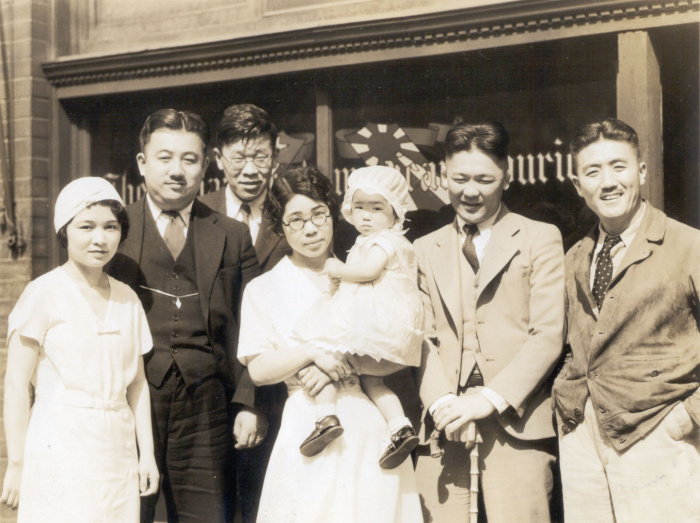
Boxer, newspaper publisher, and Japanese American Citizens League (JACL) founder. James "Jimmie" Sakamoto (1903–55) was an influential leader of one segment of the Nisei community before World War II. Urging fellow Nisei down an Americanization path in his Seattle-based newspaper, the Japanese American Courier , the blind former boxer was also one of the architects of the JACL philosophy. After being granted a leadership position in the administration of the Puyallup Assembly Center , his influence waned after the war. He died at age 52 from injuries sustained from getting hit by a car.
Early Life and Courier
James Yoshinori Sakamoto was born in Seattle on March 22, 1903 to Osamu and Tsuchi Sakamoto, Issei who had migrated to the U.S. from Yamaguchi prefecture in 1894. Osamu had worked in a sawmill and as a farm worker before embarking on a string of businesses that included a restaurant, hotel, and used furniture store. Jimmie attended Seattle public schools including Pacific Grammar School and Franklin High School. At Franklin, be became a star athlete despite weighing less than 130 pounds. At age seventeen, the confident high schooler testified before a U.S. House committee investigating Japanese immigration . He also tried to enlist in the U.S. Army when the U.S. entered World War I, but was turned away due to his age. [1]
Before graduating from high school, he decided to move east, finishing school in Princeton, New Jersey, and subsequently becoming the English language section editor of the Japanese American News in New York, position he held for three years. He married Frances Imai while in New York and had a daughter. He also pursued professional boxing, even fighting in Madison Square Garden. But his New York sojourn ended badly, with the untimely death of his wife and with eye injuries suffered in the ring putting him on the road to total blindness. He returned to Seattle in 1927. [2]
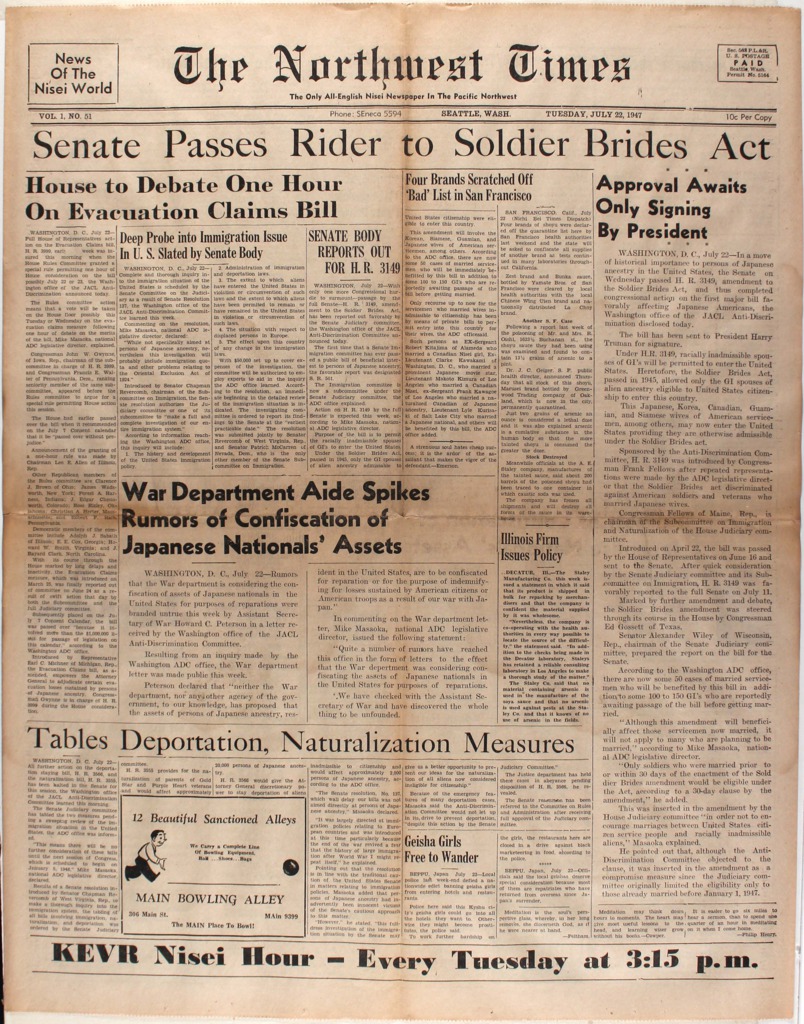
Well-known from his days as an athlete, he became involved in Japanese American community politics and in 1928, with help from his parents, he started a pioneering newspaper he called the Japanese American Courier , the first to be published entirely in English for a Nisei audience. Sakamoto also became one of the founders of the fledgling Japanese American Citizens League (JACL), serving as national president from 1936 to 1938. He also organized a sprawling Japanese American sports organization known as the Courier League that came to include dozens of teams in several sports from throughout the Pacific Northwest and that also included a number of Chinese American teams. [3] When the JACL newspaper, the Pacific Citizen , ran into difficulties in 1933, Sakamoto agreed to take it on, doing the editing and typesetting of that paper in addition to the Courier until 1939. He also remarried, to the Japan-born Misao Nishitani, and had two more daughters in the 1930s. Misao managed the business end of the newspaper—which often struggled financially—and played a key role in its survival.
Sakamoto and the Courier espoused a strong faith in American institutions and urged Nisei to do everything possible to prepare themselves to take part in those institutions. While acknowledging discrimination, he felt that Nisei could help bring down those barriers by educating other Americans and to "be able to act and to talk like their fellow Americans. If they can do that there will be no question of their being accepted by their fellows." [4] His conservative brand of Americanism also embraced anti-Communism, opposed militant labor organizations, and discouraged protest over racial issues.
At the same time, historian Yuji Ichioka also points out that Sakamoto and the paper espoused the concept of Nisei as cultural bridge between Japan and the U.S. As part of that role, he argued that Nisei were ideally suited to educate Americans about Japan. The Courier did its part by presenting the Japanese perspective on its expansionism in Asia from 1931 to 1940, decrying the perceived pro-China position of most other American publications. He also encouraged Nisei to learn the Japanese language (Sakamoto himself was bilingual and "as forceful an orator in Japanese as he was in English" according to JACL chronicler and friend Bill Hosokawa ) and to travel to Japan to get first hand knowledge of Japanese cultural and society, as he did in 1931. He did not see any of this as being contradictory to promoting Americanism; indeed Nisei would be better Americans by playing the "bridge" role.
The Crisis of War
As tensions between the U.S. and Japan rose in 1940, the "bridge" concept became untenable, and the paper doubled down on the Americanism theme, promoting unquestioned patriotism. After the Japanese attack on Pearl Harbor, he became chair of the newly formed JACL Emergency Defense Council. In January, that group issued a statement in which they pledged "to uncover all subversive activity in our midst, and if need be we are ready to stand as protective custodians over our parent generation to guard against danger to the United States arising from our midst." The Courier continued to publish into 1942, and, when the exclusion orders came down, advocated cooperation with them "loyally" and "cheerfully." The Courier' s last issue was dated April 24, 1942.
Most of the Japanese population in Seattle was sent to the Puyallup Assembly Center, built on the site of a fairgrounds 35 miles to the south. In a unique arrangement, local army officials largely turned over administration of the camp to the JACL Emergency Defense Council. Sakamoto became "chief supervisor" of the "Japanese staff." Puyallup historian Louis Fiset cites Sakamoto's management style and appointment of JACL friends to other top positions as a source of dissension in the camp with the leadership group being accused of enacting a dictatorial management style and enjoying benefits not available to others. When a new manager, J. J. McGovern, took over at Puyallup on May 23, he launched an investigation that concluded that Sakamoto's group had been given too much power and dissolved the "Japanese administration" on June 9. The problems tied to Sakamoto's group at Puyallup—along with similar issues with a JACL-led leadership group at the Sacramento Assembly Center—likely influenced the WCCA to ban inmate self-government in the assembly centers. In the meantime, tensions ran so high at Puyallup, that some inmates plotted to assassinate Sakamoto. [5]
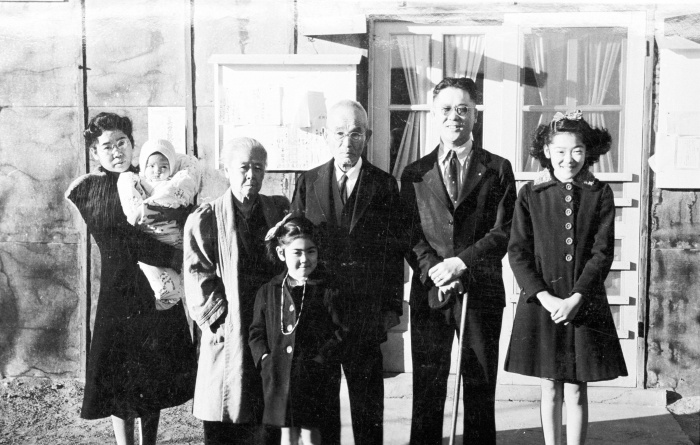
Along with nearly the entire Puyallup population, the Sakamotos moved on to the Minidoka, Idaho, War Relocation Authority administered detention facility, arriving on August 18, 1942. Given what had transpired at Puyallup, Minidoka officials insured that there not be any overt leadership role for the JACL group, including Sakamoto, and he seemingly kept a low profile there. He did remain active in the JACL, serving at one of the Minidoka delegates in the December 1942 JACL conference in Salt Lake City, and wrote a poem titled "Nisei's Stars and Stripes" dedicated to the Nisei soldiers, that was published in the anniversary issue of the Minidoka Irrigator on September 16, 1944. Additionally, a third daughter was born to the Sakamotos in 1943. [6]
After the War and Legacy
In August of 1944, Misao and the two older daughters left to resettle in Indiana, while Jimmie stayed behind with the youngest daughter and his elderly parents. They stayed in Minidoka almost to the end, leaving for Seattle on September 4, 1945, where the rest of the family eventually joined them. [7]
Though Sakamoto considered restarting the Courier , he opted instead to find an occupation that would provide a steadier income for a growing family. Having converted to Catholicism, Father Leopold Tibesar helped Sakamoto land a job with the Society of St. Vincent de Paul, a Catholic charity organization in Seattle. There, he led a staff of disabled telephone and mail solicitors for the charity. He remained there for the rest of his life. [8]
On December 3, 1955, he was hit by a car while crossing a street on his way to work and died later that day. Lauded for his early role in the JACL in the Pacific Citizen and in subsequent articles and books about the JACL by his friend Bill Hosokawa, he remained a well-known figures after his passing. In 1995, a basalt stone monument in tribute to Jimmie and Misao Sakamoto and the Courier League was dedicated at the Seattle Keiro Nursing Home. [9]
For More Information
Daniels, Roger. Asian America: Chinese and Japanese in the United States since 1850 . Seattle: University of Washington Press, 1988.
Fiset, Louis. Camp Harmony: Seattle's Japanese Americans and the Puyallup Assembly Center . Urbana: University of Illinois Press, 2009.
Hosokawa, Bill. "What Became of Jimmie Sakamoto?" Scene Magazine, Jan. 1950, 20–21.
———. " Blind, But with Vision ." Pacific Citizen , December 23, 1955, A4–6, 11.
———. Nisei: The Quiet Americans . New York: William Morrow & Co., 1969.
———. JACL in Quest of Justice: The History of the Japanese American Citizens League . New York: William Morrow, 1982.
Ichioka, Yuji. "A Study in Dualism: James Yoshinori Sakamoto and the Japanese American Courier, 1928-1942." Amerasia Journal 13.2 (1986-87): 49-81.
———. Before Internment: Essays in Prewar Japanese American History . Edited by Gordon H. Chang and Eiichiro Azuma. Stanford: Stanford University Press, 2006. [This compilation includes the earlier article listed above.]
Takahashi, Jere. Nisei/Sansei: Shifting Japanese American Identities and Politics . Philadelphia: Temple University Press, 1997.
Footnotes
- ↑ Bill Hosokawa, "Blind, But with Vision," Pacific Citizen , Dec. 23, 1955, A-5.
- ↑ Hosokawa, "Blind, But with Vision," A-5.
- ↑ For more on the Courier League, see Samuel O. Regalado, "Play Ball—Baseball and Seattle's Japanese-American Courier League, 1928-1941" Pacific Northwest Quarterly 87.1 (Winter 1996): 29-37 and Nikkei Baseball: Japanese American Players from Immigration and Internment to the Major Leagues (Urbana: University of Illinois Press, 2013), 70–90; and Shelley Sang Hee Lee, Claiming the Oriental Gateway: Prewar Seattle and Japanese American (Philadelphia: Temple University Press, 2011): 142–77.
- ↑ Yuji Ichioka, Before Internment: Essays in Prewar Japanese American History (Ed. Gordon H. Chang and Eiichiro Azuma; Stanford: Stanford University Press, 2006), 96–97.
- ↑ Louis Fiset, Camp Harmony: Seattle's Japanese Americans and the Puyallup Assembly Center (Urbana: University of Illinois Press, 2009), 33–35, 68–70; 143–45; . J. McGovern, Report for Secretary of War, May 28, 1942, p. 6, General Correspondence Files, Puyallup Center Mananar, Report—Special to Secretary of War, Reel 104, National Archives and Records Administration, San Bruno, California, branch; For one version of the Sakamoto assassination plot, see Shosuke Sasaki Interview by Chizu Omori (primary) and Emiko Omori (secondary), Segment 12, Seattle, Washington, September 28, 1992, Densho Digital Repository, Emiko and Chizuko Omori Collection, https://ddr.densho.org/media/ddr-densho-1002/ddr-densho-1002-2-12-transcript-b56bf18774.htm .
- ↑ Minidoka Final Accountability Roster, p. 195, https://ddr.densho.org/ddr-densho-305-8-master-30a9aa812b/ ; Minidoka Irrigator , Sept. 16, 1944, Part I, p. 3, https://ddr.densho.org/ddr-densho-119-102/ .
- ↑ Hosokawa, "Blind, But with Vision," A-5; Minidoka Final Accountability Roster.
- ↑ Bill Hosokawa, "What Became of Jimmie Sakamoto?" Scene Magazine , Jan. 1950, 20–21.
- ↑ Pacific Citizen , Dec. 9, 1955; Hideo Hoshide, "Sakamoto monument to be unveiled September 10," "JACL Seattle Chapter Newsletter", Aug. 1995, 1, 3.
Last updated Jan. 6, 2026, 9 p.m..