Densho Encyclopedia

Alien Enemies Act of 1798
The Alien Enemies Act of 1798 was one of four laws known as the Alien and Sedition Acts, which imposed increased press regulations and restrictions on aliens. It was used as the basis for incarcerating enemy aliens and confiscating their property during World War II. As a result, a number of Japanese, Germans, and Italians were arrested and interned for the duration of the war and were later deported to their nations of origin. Recently, the act has been invoked by the Trump administration to remove alleged members of international criminal cartels, sparking protests and lawsuits that challenge presidential authority and war powers.
Origins of the Act
In 1798, the United States was on the verge of war with France. The Federalists, America's first political party, believed that Democratic-Republican criticism of their policies was disloyal. Additionally, they feared that aliens living in the United States would sympathize with the French during a war. As a result, a Federalist-controlled Congress passed four laws, collectively known as the Alien and Sedition Acts. These laws raised the residency requirements for citizenship from five to fourteen years and made aliens "liable to be apprehended, restrained, secured, and removed" in the Alien Enemies Act of 1798. [1] However, these acts sparked a firestorm of criticism against the Federalists, revealing the limits of freedom of speech and the press and contributing to their defeat in the election of 1800. Currently, the Alien Enemies Act of 1798 is still in force in modified form and authorizes the President to detain, relocate, or deport enemy aliens in time of war.
Historical Usage of the Act
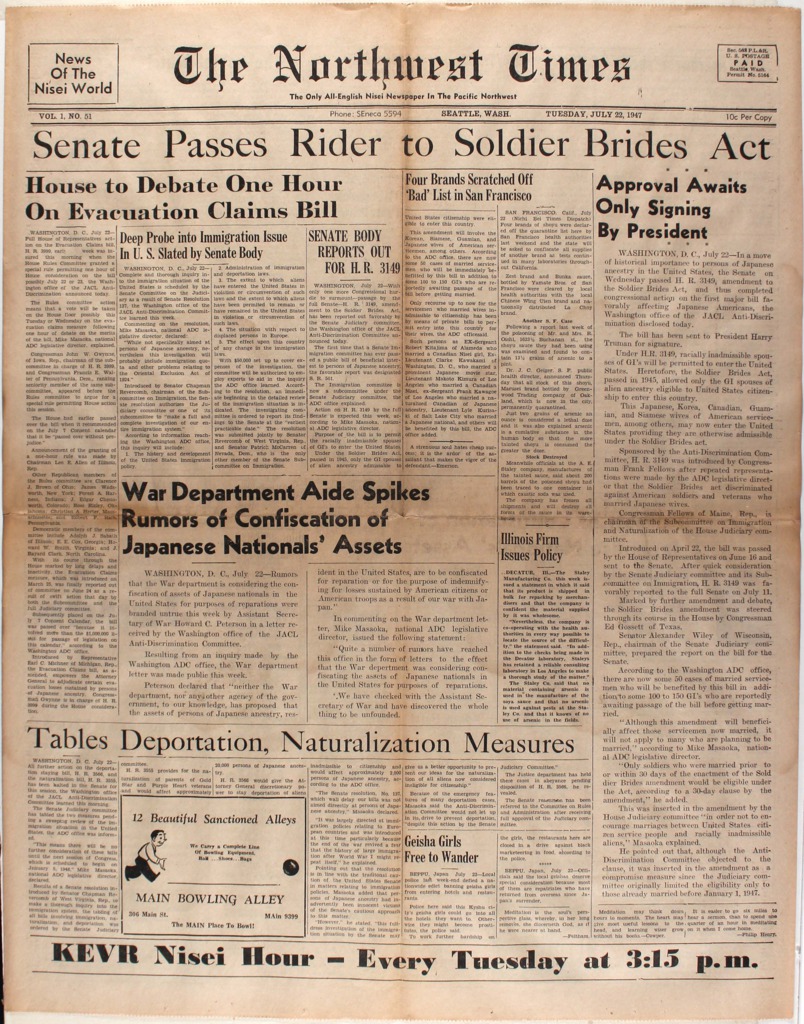
While this act was invoked during the War of 1812 and in World War I, in 1941, the Alien Enemies Act was utilized by government officials to incarcerate Japanese Americans. Immediately after Pearl Harbor, President Franklin Delano Roosevelt signed Proclamation 2525 in accordance with the Alien Enemies Act, giving the government the authority to detain enemy aliens and confiscate enemy property. The Proclamation permitted immediate apprehension of "alien enemies deemed dangerous to the public health or safety of the United States by the Attorney General or Secretary of War." [2] On December 8, 1941, similar proclamations were issued for the arrest of suspect Germans and Italians. By February 16, 1942, the Department of Justice held 2,192 Japanese, 1,393 Germans, and 264 Italians, and arrests continued even after that date. Many arrested were Issei leaders of the Japanese American community and its organizations.
Upon the conclusion of World War II, some internees used the Alien Enemies Act to block their deportation to Axis states. Some German internees from Latin American countries filed habeas corpus petitions challenging their detention by the United States, claiming that they were not "alien enemies" as defined by the Alien Enemy Act of 1798, because they were not natives or citizens of an enemy country. In January 1946, this effort failed when a federal district court ruled that the Latin American internees were "alien enemies" who could legally be detained. After this decision, 513 Japanese (over ninety percent from Peru), 897 Germans, and 37 Italians from Latin America in United States internment camps were granted hearings pending deportation. [3] The hearings were a formality leading to their deportation to Axis countries, although most of the remaining Latin American Japanese wished to return to Peru. Voluntary repatriation continued into 1946, with at least 130 Peruvian Japanese returning to Japan by June. (See Japanese Latin Americans .)
Contemporary Usage
Although the Alien Enemies Act was enacted to prevent foreign espionage, the Trump administration has invoked this act as the legal basis for the deportation of 261 alleged Tren de Aragua (TdA) Venezuelan gang members to a notorious prison in El Salvador without due process. On January 20, 2025, President Donald J. Trump issued an executive order (E.O.) declaring a national emergency to address the alleged threat posed by international cartels and certain transnational organizations to U.S. national security. [4] Trump specifically invoked the Alien Enemy Act, declaring that TdA “is perpetrating, attempting, and threatening an invasion or predatory incursion against the territory of the United States.” [5]
Since its invocation, various civil rights groups have filed lawsuits challenging the President's authority to remove individuals from the United States under these circumstances. [6] Recently, the U.S. Court of Appeals for the Fifth Circuit ruled that the Alien Enemies Act cannot be used to deport individuals in peacetime or to bypass standard immigration courts. While federal judges have ordered the Trump administration to help previously deported men return to the U.S. to face proper immigration hearings, as their constitutional rights to due process were violated, the administration is appealing the court’s decision, resulting in ongoing legal battles over presidential war and emergency powers. [7]
For More Information
Christensen, Erika L. "Face of the Enemy: the Japanese-American Internment and its Significance on Ethnic Conflict in America." Master's thesis, Utah State University, 2010.
Commission on Wartime Relocation and Internment of Civilians. Personal Justice Denied: Report of the Commission on Wartime Relocation and Internment of Civilians . Seattle: University of Washington Press, 1997.
German American Internee Coalition.
Miller, John Chester. Crisis in Freedom: the Alien and Sedition Acts . Boston: Little, Brown, 1951.
Miyake, Lika C. "Forsaken and Forgotten: The U.S. Internment of Japanese Peruvians During World War II" (May 2002): 18666 words.
Neuman, Gerald L., and Charles F. Hobson. "John Marshall and the Enemy Alien." The Green Bag (Autumn 2005).
Peltner, Arndt. "Unforgettable Justice." The Atlantic Times , May 2007.
Presidential Proclamation 2525.
Stone, Geoffrey R. Perilous Times: Free Speech in Wartime From the Sedition Act of 1798 to the War on Terrorism . New York: W.W. Norton & Co., 2004.
United States. National Archives and Records Administration. Our Documents: 100 Milestone Documents from the National Archives . New York: Oxford University Press, 2003.
Alien Enemy Act: History and Potential Use to Remove Members of International Criminal Cartels , Congress.gov website, April 2, 2025.
Footnotes
- ↑ United States, National Archives and Records Administration, Our Documents: 100 Milestone Documents from the National Archives (New York: Oxford University Press, 2003), 10.
- ↑ Commission on Wartime Relocation and Internment of Civilians, Personal Justice Denied: Report of the Commission on Wartime Relocation and Internment of Civilians (Seattle: University of Washington Press, 1997), 54.
- ↑ Personal Justice Denied , 312.
- ↑ “Designating Cartels and Other Organizations as Foreign Terrorist Organizations and Specially Designated Global Terrorists” , The White House, January 20, 2025.
- ↑ “Invocation of the Alien Enemies Act Regarding the Invasion of the United States by Tren de Aragua” , Proclamation 10903 of March 14, 2025, Federal Register.
- ↑ “Trump's Deportation Flights Under the Alien Enemies Act”, American Civil Liberties Union website. Accessed May 26, 2026.
- ↑ “Judge orders Trump administration to help dozens of deportees return to the US”, Josh Gerstein and Kyle Cheney, Politico, February 12, 2026. Accessed May 26, 2026.
Last updated May 27, 2026, 6:35 p.m..