Densho Encyclopedia

 Media
Media
Yasui v. United States
Yasui v. United States was one of four cases challenging the wartime treatment of Japanese Americans that reached the United States Supreme Court. Minoru Yasui intentionally violated the curfew order issued against Japanese Americans, believing that the government's actions were unconstitutional because they discriminated against Japanese Americans based on their race. He was convicted of violating the curfew order and appealed to the Supreme Court. The Court, however, upheld the government's actions, reasoning that they were based on military necessity. [1]
Yasui's Act of Resistance
Minoru Yasui was a twenty-five-year-old lawyer when he violated DeWitt's curfew order to test its legality. Unable to find a job after he graduated from the University of Oregon School of Law, he was able to obtain work with the Japanese Consulate in Chicago with the assistance of his father, Masuo Yasui . A few days after the bombing of Pearl Harbor, as a commissioned officer in the army infantry reserve, he reported for duty at Fort Vancouver, Washington, but, on his arrival, he was told he was told he could not serve.
Back in Portland, Yasui heard rumors that the government had plans to round up American citizens of Japanese ancestry like him, and he resolved to challenge them. He consulted with Portland lawyer Earl F. Bernard, who, although believing the government's actions were lawful, agreed to represent Yasui in any challenge he might bring. He also met with Frank Nash, a former law school classmate and FBI agent, and Carl Donaugh, then United States Attorney for the District of Oregon, to talk about "what the government could and could not do." He told Donaugh that he would bring a test case if the government took action against Japanese Americans.
Yasui sought other Japanese American citizens willing to bring a test case, but, failing to find any, he resolved to violate the first orders that he could—the curfew orders—himself. While he believed that the government could issue such an order against immigrant Japanese, he felt it could not issue such orders against an American citizen. And, while he did not object to orders made to protect the public, in general, they could not be discriminatorily applied. On Saturday, March 28, 1942, the first evening the curfew was in effect, he got himself arrested. He remained in the drunk tank in jail over the weekend until Earl Bernard bailed him out.
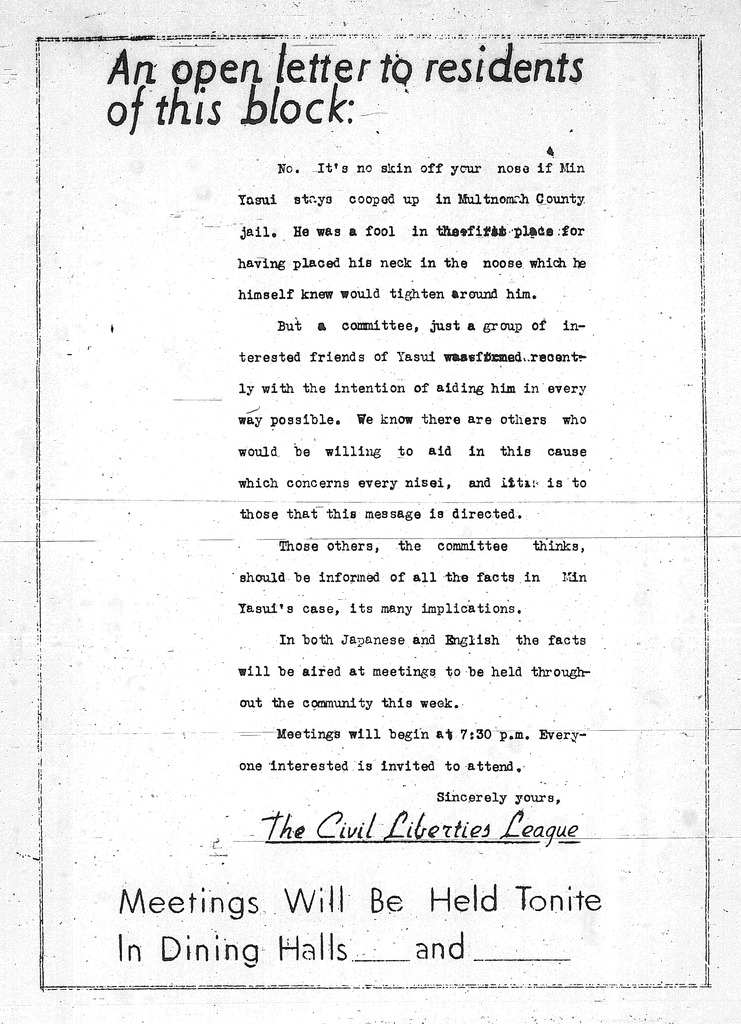
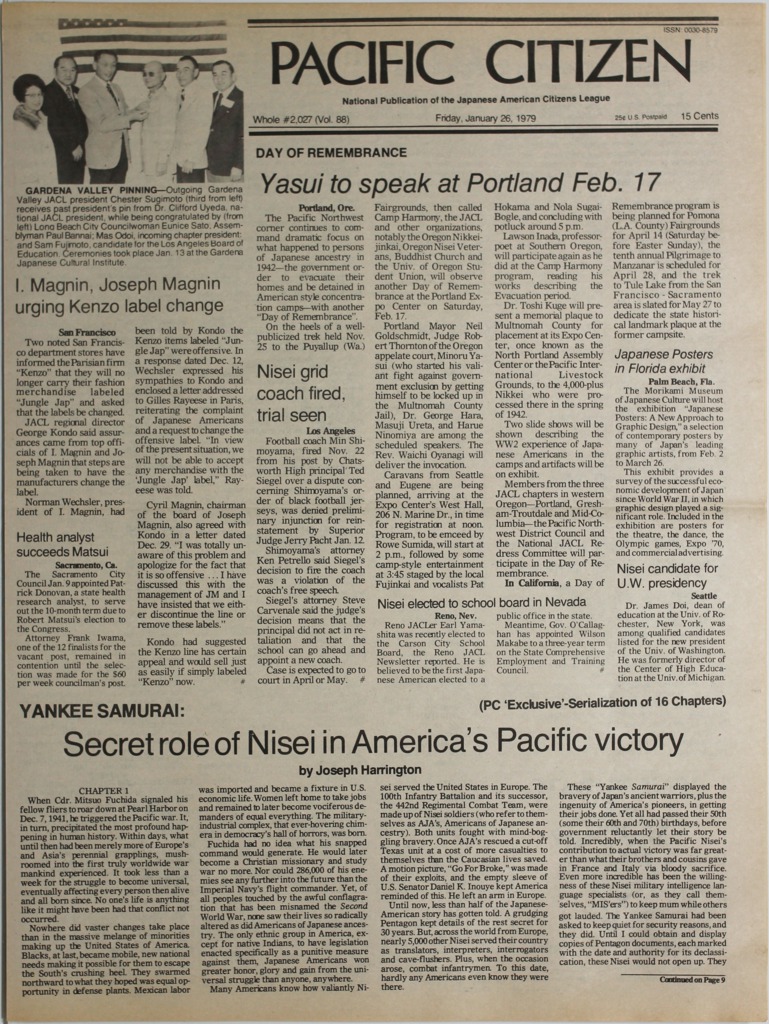
Both the National American Civil Liberties Union (ACLU) and the Japanese American Citizens League (JACL) declined to support him. The ACLU's decision was based on Yasui's prior connection to the Japanese consulate. The JACL saw Yasui's actions as directly undermining its stance of cooperation with the government. On April 7, 1942, in response to Yasui's act of defiance, JACL national secretary Mike Masaoka issued a bulletin stating JACL's opposition to any test cases challenging to the government's actions. In the bulletin, Masaoka recognized that "self-styled martyrs," like Yasui, who were willing to be jailed to fight for the rights of citizenship, "capture the headlines and the imaginations of many more persons than our seemingly indifferent stand." However, Masaoka continued, the organization had already pledged cooperation to the president and a challenge to the orders would further turn public opinion against the community. Masaoka concluded, "In times like these, let us remember that it is much easier to be a martyr than it is to be a quiet, self-suffering good citizen who is vitally interested in the winning of the war." [2]
Yasui's Conviction at Trial
In May 1942, Yasui and other Japanese Americans in the Portland area were ordered to report for removal and imprisoned in the North Portland Livestock Exhibition Building . [3] Shortly thereafter, on June 12, 1942, Yasui was brought before Judge James Alger Fee for trial. Earl Bernard, representing Yasui, chose to waive Yasui's right to a jury trial, and instead have the case heard by Judge Fee. There was no question that Yasui had violated the curfew order. Instead, there were two main questions. The first was whether Yasui had forfeited his American citizenship by working at the Japanese consulate because, if he did, he had fewer rights as a Japanese national. The second question, following from the first, would be whether the government's actions were constitutionally applied to him.
As to the first question, whether Yasui remained an American citizen, the government presented the form Yasui had signed when he registered with the State Department as an agent of the Japanese government. And at one point, Judge Fee himself took over questioning Yasui, pressing him on whether his family had practiced Shintoism, the national religion of Japan.
As to the second question, whether the government's actions were constitutionally justifiable, the prosecutors unveiled the argument they would use in the other cases challenging the government's wartime actions, like Hirabayashi and Korematsu . They sought to produce an expert witness to testify that persons of Japanese ancestry, based on their "racial characteristics"—including connections with Japanese culture and social isolation—might be prone to be disloyal. However, Judge Fee agreed with Yasui's lawyer Bernard that "what some of the Japanese might do under certain circumstances" was not the proper subject of expert testimony.
In September 1942, Yasui and others from the Portland Livestock Exhibition Center were transferred to the Minidoka concentration camp in Idaho. [4] There, he awaited Judge Fee's decision. Finally, in November, he was taken by military escort to Judge Fee's Portland courtroom. [5]
Judge Fee's opinion, issued November 16, 1942, was remarkable in being the only judicial opinion that concluded that the military orders could not constitutionally be enforced against American citizens of Japanese descent. No other court reached that conclusion, in Yasui's case or the Hirabayashi , Yasui , or Endo cases that followed. Judge Fee explained that a military commander had no power to issue orders against civilians absent a declaration of martial law or the presence of military jurisdiction, and, at the time of Yasui's arrest, there were neither. In contrast, such orders could be issued against Japanese nationals. [6]
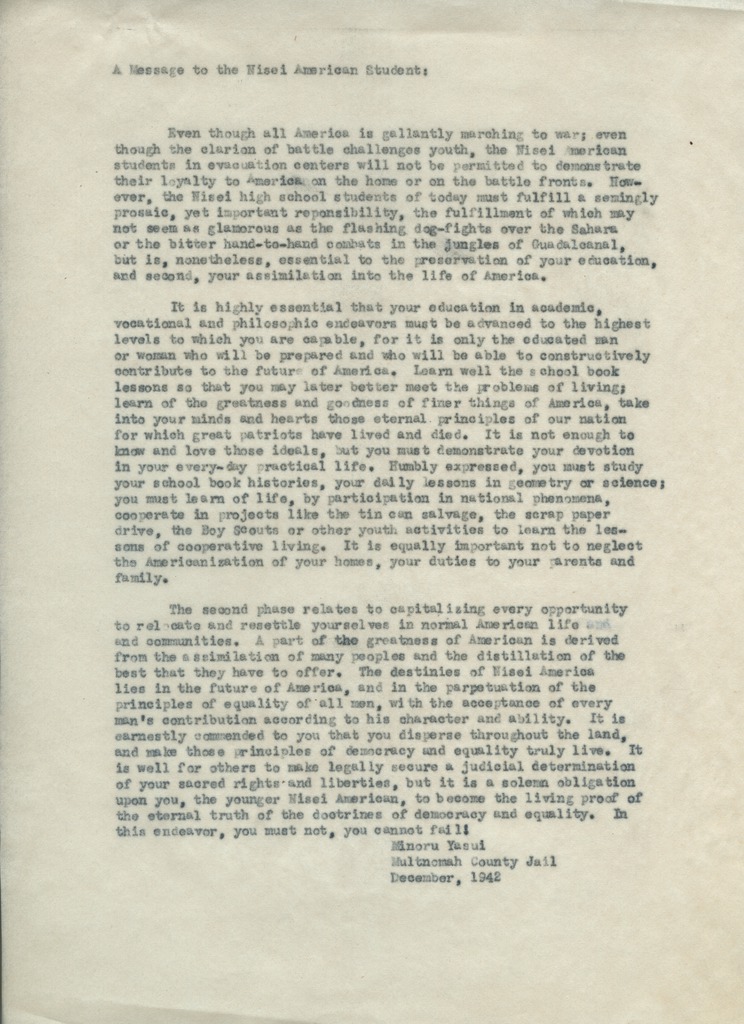
However, Judge Fee then went on to find that Yasui had "repudiated his [U.S.] citizenship' in the eyes of the law by working for the Japanese Consulate General. Judge Fee even implied that Yasui had left that job and returned to Oregon so that he could better serve his sovereign as a commissioned officer in the United States armed forces. Because the military could properly issue its curfew order against Japanese nationals, Yasui was guilty as charged. [7] He was sentenced to the maximum penalty of one year in jail and a fine of $5,000, and held in solitary confinement in the Multnomah County Jail while he appealed his case. [8]
Yasui's Appeal to the Supreme Court
The U.S. Court of Appeals for the Ninth Circuit heard oral argument in Yasui's appeal the same day it heard the appeals in the Hirabayashi and Korematsu cases. Rather than decide the cases itself, the court certified legal questions in each of the three novel cases directly to the U.S. Supreme Court. In other words, rather than follow the normal course of appeals in which the Ninth Circuit would rule before the Supreme Court, the Ninth Circuit asked the Supreme Court to rule on certain questions first. In Yasui's case, the Supreme Court was asked to decide both the constitutionality of the curfew order and whether Yasui had renounced his citizenship.
The Supreme Court heard oral arguments on all three cases— Yasui , Hirabayashi , and Korematsu —on May 10 and 11, 1943. [9] By this time, the government had already conceded that Yasui had not renounced his citizenship. Regardless, Yasui's lawyer Earl Bernard argued that Judge Fee's ruling stripped Yasui of all of the cherished incidents of American citizenship, including the rights to vote and to pursue his livelihood. In addition, in his brief, Bernard had vigorously argued that the government's orders unlawfully discriminated against citizens of Japanese ancestry on the basis of their race. [10] In response, Solicitor General Charles Fahy did not focus on the issue of Yasui's citizenship. Instead, he argued, in response to both Yasui's and Hirabayashi's cases, that the curfew orders were constitutional even when applied to citizens. The government, he argued, had broad power during times of war, and, based on the "racial characteristics" of Japanese Americans—an argument that had failed before Judge Fee—the government's actions were justified.
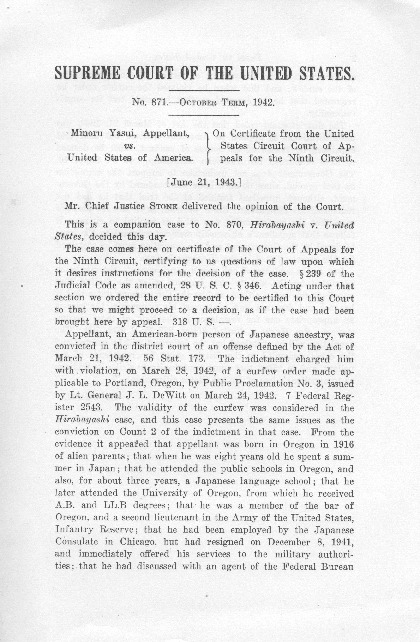
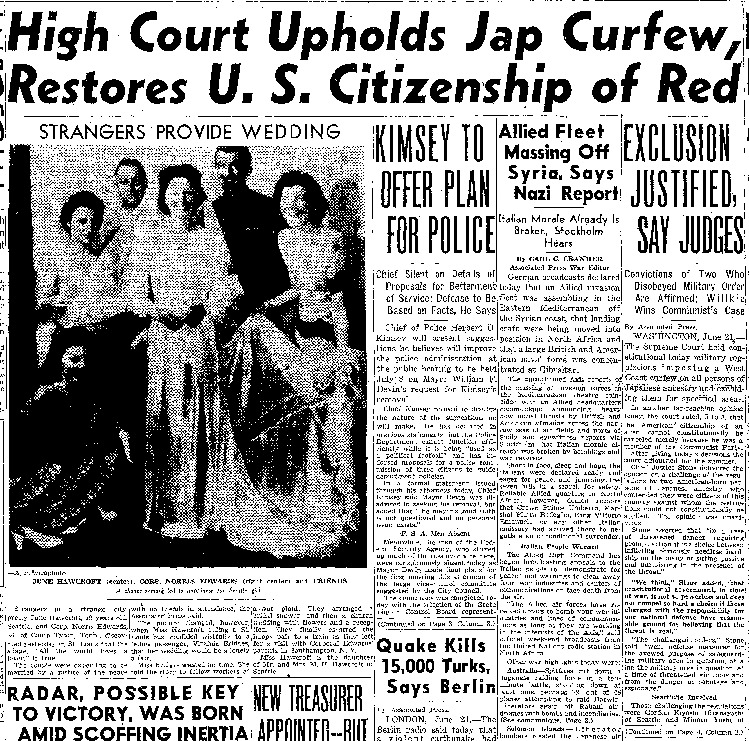
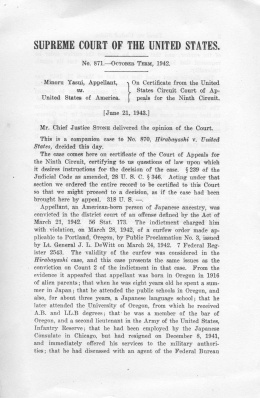
A unanimous U.S. Supreme Court issued its Hirabayashi and Yasui opinions on the same day, June 21, 1943. Because both opinions addressed the constitutionality of only the government's curfew orders, the Court issued a lengthier opinion in Hirabayashi and then a briefer opinion upholding Yasui's conviction on the same grounds. In Hirabayashi , the Court stated that great deference had to be given the government on issues related to national security. [11] The Court, agreeing with the government's "racial characteristics" argument, said that it could not second guess the judgment of military authorities that cultural ties to Japan and social isolation might have made Japanese Americans prone to disloyalty. [12] In its less-than-two-page decision in Yasui, the Court said that Yasui's conviction had to be sustained for the reasons stated in Hirabayashi . [13] However, the Supreme Court sent Yasui's case back to Judge Fee for resentencing, given that the severe sentence was imposed based on the erroneous finding that Yasui had denounced his citizenship. [14]
Fee considered the nine months Yasui had already served as sufficient and suspended the fine. [15] On August 19, 1943, he was "released" from prison only to be escorted by a U.S. marshal back to the American concentration camp at Minidoka. [16]
Newly Discovered Evidence and the Reversal of Yasui's Conviction
Forty years later, in the early 1980s, Yasui was able to reopen his wartime case. Newly discovered evidence proved that the government had suppressed, altered, and destroyed material evidence that contradicted its claims of military necessity while arguing his World War II case was before the Supreme Court. Based on that evidence that the government lied to the Court, Yasui filed a petition to reverse his conviction. The government, in response, agreed to reverse Yasui's conviction, but argued that there was therefore no need for the court to address the evidence of government misconduct. The court agreed. Yasui appealed the court's decision, arguing that the court should have addressed the claims of government fraud, but he died before his appeals were heard. His wartime conviction, however, had been reversed, and he continued to speak widely about the wartime incarceration and his case.
For More Information
Bangarth, Stephanie. Voices Raised in Protest: Defending Citizens of Japanese Ancestry in North America, 1942–49 . Vancouver: UBC Press, 2008.
Irons, Peter. Justice at War: The Story of the Japanese American Internment Cases . New York: Oxford University Press, 1983. Berkeley: University of California Press, 1993.
Kessler, Lauren. Stubborn Twig: Three Generations in the Life of a Japanese American Family . New York: Random House, 1993.
Minoru Yasui Legacy Project, https://www.minoruyasuilegacy.org/
Never Give Up: Minoru Yasui and the Fight for Justice . directed by Holly Yasui and Will Doolittle, 2017. 56 min.
United States v. Minoru Yasui, 48 F. Supp. 40 (D. Oregon 1942) .
Footnotes
- ↑ Much of this article is drawn from Peter Irons, Justice at War: The Story of the Japanese American Internment Cases (New York: Oxford University Press, 1983 and Berkeley: University of California Press, 1993.).
- ↑ Bulletin 142, Japanese American Citizens League, Office of the National Secretary, 1–2, Apr. 7, 1942, American Civil Liberties Union of Northern California Records, California Historical Society MS 3580, Carton 28, Folder 592; Irons, Justice at War , 85.
- ↑ Never Give Up: Minoru Yasui and the Fight for Justice , directed by Holly Yasui and Will Doolittle, https://www.minoruyasuilegacy.org/never-give-up . Yasui actually returned to the Yasui family home in Hood River before military police went to pick him up and transport him to the North Portland camp. Minoru Yasui Interview, Segment 6, Hood River, Oregon, Oct. 23, 1983, Steven Okazaki Collection, Densho Digital Repository, https://ddr.densho.org/media/ddr-densho-1012/ddr-densho-1012-3-6-transcript-046f5bf9d0.htm .
- ↑ Never Give Up film.
- ↑ Never Give Up film.
- ↑ United States v. Minoru Yasui , 48 F. Supp. 40, 48-49 (D. Oregon 1942).
- ↑ United States v. Minoru Yasui , 48 F. Supp. 40, 55 (D. Oregon 1942).
- ↑ Never Give Up film.
- ↑ Amicus briefs in support of both Yasui and Hirabayashi were filed by the Northern California branch of the ACLU and, in a turnabout from its prior opposition to cases challenging the incarceration, the national Japanese American Citizens League.
- ↑ Brief of Appellant, Yasui v. United States, No. 871, 1943 WL 54783, at *48 (Apr. 30, 1943).
- ↑ The Court in Hirabayashi stated that where the conditions call for the warmaking branches of government to exercise their discretion, "it is not for any court to sit in review of the wisdom of their action or substitute its judgment for theirs." Hirabayashi v. United States , 320 U.S. 81, 93 (1943).
- ↑ Hirabayashi v. United States , 320 U.S. 81, 96-98 (1943).
- ↑ United State v. Minoru Yasui , 320 U.S. 115, 116-17 (1943).
- ↑ United State v. Minoru Yasui , 320 U.S. 115, 117 (1943).
- ↑ Lauren Kessler, Stubborn Twig: Three Generations in the Life of a Japanese American Family (New York: Random House, 1993), 197.
- ↑ Never Give Up film.
Last updated July 7, 2025, 8:56 p.m..